


The Cycle of Brand Communities
There is a moment in every space brand’s journey when it becomes clear that propulsion, precision, and engineering excellence are not enough. The real gravity that holds an ecosystem together is the community that forms around the brand’s purpose. People gather when they believe something larger than themselves is underway. They stay when they feel that they belong in the mission. Building that kind of community is not an act of marketing. It is an act of leadership.
When I work with space brands, I describe community building as a cycle, not a campaign. It is a long arc of intention, execution, patience, and stewardship. And it always begins with a decision: the decision to treat your audience not as followers, but as fellow travelers. Once that decision is made, the brand community strategy execution cycle begins.
My study of 53 companies with successful brand communities has revealed the following four-phase development arc:
Four Phased Cycle
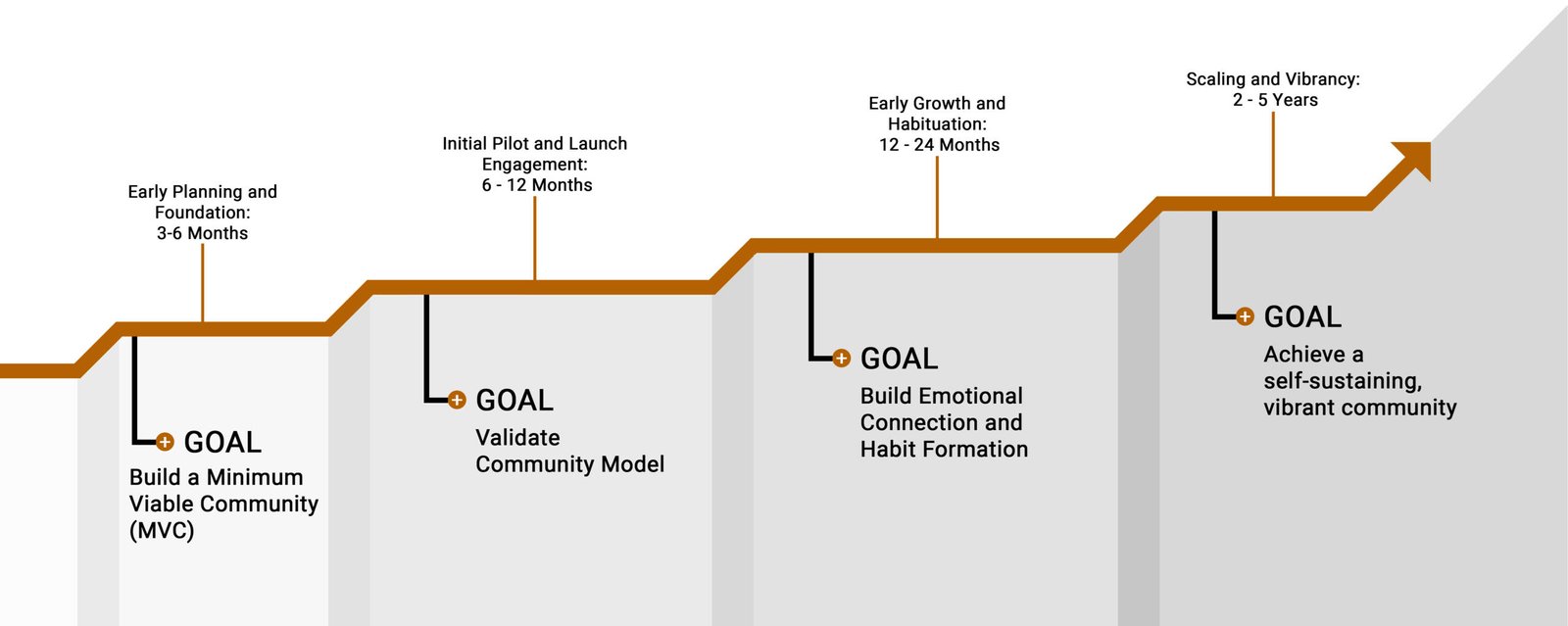
Early Planning and Foundation (3–6 Months)
Every strong community begins with quiet work. Before platforms launch, before the first member joins, the brand must know why it wants a community. A space brand thrives on clarity, so this stage demands hard questions. What is the purpose? Who are the people you seek to gather? What values guide the journey? You map potential platforms, set early KPIs, and define a Minimum Viable Community that serves as the scaffolding for everything that will follow. I have always believed that identity shapes gravity. When you define the identity well, the right people begin to orbit.
This foundation stage is often unglamorous, but it is indispensable. Without it, everything built later becomes driftwood in the current.
Initial Launch and Pilot Engagement (6–12 Months)
Then the lights come on. The brand launches its community platforms-forums, social channels, town halls, online and in-person gatherings. You invite early adopters, those rare first believers who sense potential before others see it. You test messaging, experiment with content, and introduce simple engagement rituals. Nothing is fully formed yet, but something is beginning to breathe.
The goal here is validation. You observe emerging patterns. You listen as much as you speak. You collect early stories and successes. A community is not declared into existence. It reveals itself through its interactions. This pilot year is where that revelation begins.
Early Growth and Habituation (12–24 Months)
If the foundation is solid and the pilot stage is handled with humility and attention, the community begins to change shape. You see members returning without prompting. You see conversations that you did not start. You see the early signs of emotional connection.
This is the period when you scale engagement activities and begin to build subgroups that reflect deeper interests within the space ecosystem. You articulate community norms and values. You design recognition programs that reward contribution and deepen belonging. Most important, you build habit. Communities become vibrant when participation becomes part of a person’s weekly, sometimes daily, rhythm. When that happens, you are no longer pushing the community forward. You are guiding momentum that already exists.
Scaling and Vibrancy (2–5 Years)
The true community emerges when the brand is no longer the sole engine of its growth. This is the long view that many leaders underestimate. Vibrant communities do not form overnight. They mature over years.
In this phase, the brand formalizes governance structures and launches ambassador programs. Members begin to shape the culture, language, and expectations. Feedback loops become institutional. Community behavior links directly to brand outcomes. The ecosystem becomes self-sustaining. People join because others are already there. Values spread because members reinforce them. The community becomes a force multiplier for everything the brand attempts.
This is the moment when a space brand ceases to be a logo and becomes a living environment.
Historical Benchmarks
We have seen the pattern repeat itself across industries. Consumer tech brands like Apple and LEGO took three to five years to build globally recognized, self-sustaining communities. Professional and niche B2B ecosystems often establish strong engagement in two to four years. Gaming and fandom communities ignite fast with initial vibrancy emerging in months, but deep loyalty still takes several years to solidify. The timelines differ, but the developmental arc is constant.
What Determines Growth Speed?
Five factors accelerate or slow the journey:
- Clarity of Purpose: A mission that matters builds momentum.
- Advocate Engagement: Founding members create credibility and cultural DNA.
- Alignment with Brand Strategy: A community without strategic integration eventually loses energy.
- Feedback Loops: Iterative learning compresses time and sharpens engagement.
- Resourcing: Dedicated teams and platform investment shorten the path to vibrancy.
When these factors align, the community builds faster. When they do not, it lingers in orbit without achieving escape velocity.
The Bottom Line
For a space brand, a vibrant, self-sustaining community typically takes two to five years to fully develop, from planning to full realization. Early engagement and meaningful signs of traction often appear within the first six to twelve months, but true vibrancy is a long-term investment. It is-a discipline, a philosophy, and a cultural engine.
A brand community is not built by accident. It is built by purpose, patience, and repeated human acts of connection. When executed well, the community becomes the brand’s most enduring asset and the clearest expression of why the mission matters.
NewSpace Brand Builders has developed a unique process to map this entire timeline to show exactly when associative triggers and community-building actions create the greatest lift. That mapping turns this general process into a phased strategic blueprint for brand community vibrancy.
About the Author
Michael Daily, APR, has been providing strategic communications and branding strategy expertise and support to organizations since 1996. He is the owner of NewSpace Brand Builders, a firm specializing in strategic communications and brand design, strategy, and management within the Space and Defense Industry. You can reach Mike at mike.daily@newspacebb.com