


BOOK REVIEW
“Space is Open for Business”
by Robert C. Jacobson (September 2020)
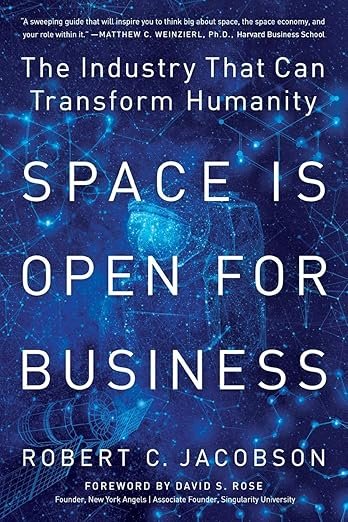
Robert C. Jacobson did not write Space Is Open for Business as a branding book, yet for space supply chain businesses it may be one of the clearest early warnings about why branding would eventually become an operational necessity rather than a promotional option. Read through a modern lens, the book captures the moment when space began its transition from a closed, government-dominated environment to a competitive commercial ecosystem. That transition fundamentally changed how companies would need to signal credibility, seriousness, and survivability.
Jacobson makes one point repeatedly and unmistakably: space is no longer the exclusive domain of governments. That single idea reshapes everything for suppliers. When markets open, differentiation becomes unavoidable. In closed systems, relationships and contracts sustain companies. In open systems, perception and positioning begin to matter because choice enters the equation. For space supply chain businesses, this marked the beginning of branding as a strategic requirement, even if the industry did not recognize it at the time.
One of the central lessons in the book is that commercialization introduces scrutiny. Jacobson emphasizes that private capital, public markets, and nontraditional stakeholders bring new expectations of transparency, discipline, and accountability. He warns that companies entering commercial space must operate with business rigor, not experimental optimism. For supply chain businesses, this translates directly into brand responsibility. A brand that overpromises or lacks coherence becomes a liability when investors, partners, and customers evaluate long-term risk.
Jacobson also highlights that space businesses must earn trust repeatedly, not just once. He notes that space ventures operate under intense visibility, where failures are public and confidence is fragile. In branding terms, this reinforces a critical lesson: reputation compounds slowly and collapses quickly. Supply chain companies cannot rely on isolated successes or technical brilliance alone. Their brand must consistently reinforce reliability, governance, and realism. In space markets, trust is cumulative, and branding is how that accumulation becomes visible.
Another enduring lesson comes from Jacobson’s discussion of capital. He observes that space companies require patient, informed investment and that misunderstanding between technologists and investors often leads to failure. For supply chain businesses, branding becomes the translation layer. A strong brand strategy communicates not only what a company builds, but how it thinks, plans, and manages risk. Jacobson makes clear that investors back management teams they believe understand the business environment, not just the technology. Branding is how that understanding is signaled before financial models ever close.
Jacobson also warns against importing assumptions from terrestrial markets without adaptation. He argues that space is commercially promising but structurally different, with longer timelines, higher stakes, and interdependent actors. This insight is foundational for branding strategy. Space supply chain businesses that brand themselves like conventional manufacturers or software firms often misalign with buyer psychology. The lesson is clear: branding must reflect the realities of space operations, not generic commercial ambition.
Perhaps the most relevant branding lesson emerges implicitly rather than explicitly. Throughout the book, Jacobson treats credibility as currency. He repeatedly underscores that space ventures succeed when they demonstrate seriousness, discipline, and an understanding of the ecosystem they operate within. For modern supply chain businesses, branding is the mechanism through which that seriousness is assessed. It answers quiet questions long before they are asked aloud. Does this company understand the consequences of failure? Does it respect the pace of the market? Does it appear built to last?
In hindsight, Space Is Open for Business reads less like a celebration of opportunity and more like a cautionary framework. It explains why space markets would eventually demand stronger brand signals, even if the industry resisted the idea for years. As space opened to commerce, branding became unavoidable, not to attract attention, but to reduce uncertainty.
For space supply chain businesses today, the lesson is straightforward. Jacobson shows that once space became a business, perception, trust, and confidence becomes as consequential as engineering. Branding is not separate from that reality. It is how the market decides who belongs in an ecosystem where failure is remembered and credibility is everything.
Book Review By
Michael Daily, APR, has been providing strategic communications and branding strategy expertise and support to organizations since 1996. He is the owner of NewSpace Brand Builders, a firm specializing in strategic communications and brand design, strategy, and management within the Space and Defense Industry. You can reach Mike at mike.daily@newspacebb.com
Article photo provided by isdc.nss.org