Skip to content Skip to footer

Strategic Compression

Strategic Compression: Why Space Communications Professionals Must Master the Art of Condensed Meaning

First, there is narrative compression.

Narrative compression distills broad institutional missions into memorable conceptual frameworks. NASA historically mastered this approach through language centered around exploration, discovery, and human advancement. Even the phrase “Mission Control” became culturally symbolic because it compressed authority, competence, discipline, and calm operational mastery into a recognizable identity construct.

Another example is the Artemis program. The name itself strategically compresses multiple ideas simultaneously:

  • Return to the Moon
  • Continuity with Apollo mythology
  • Inclusion through the symbolic female counterpart to Apollo
  • Renewal of American lunar leadership
  • Preparation for Mars

The program name performs strategic storytelling before audiences ever study mission architecture.

Second, there is visual compression.

Space organizations communicate powerfully through imagery long before audiences read technical documents or press releases. Rocket landings, astronaut photography, mission patches, launch cinematography, lunar renderings, and even typography all function as compressed symbolic signals.

The image of astronauts standing beside the American flag on the Moon remains globally recognizable because it compressed an entire geopolitical era into a single visual event.

Modern commercial firms increasingly understand this dynamic. Launch livestream aesthetics, factory tour cinematography, animated mission graphics, executive stage presentations, and spacecraft renderings now operate as strategic communication infrastructure rather than simple promotional material.

SpaceX booster landings are a modern example of visual compression. Audiences watching a first-stage booster land vertically instantly understand several messages simultaneously:

  • Technological advancement
  • Reusability
  • Precision
  • Lower-cost future access to space
  • Engineering superiority

The image communicates more efficiently than technical white papers ever could.

Third, there is organizational compression.

Internally, strategic compression aligns teams around coherent priorities. Organizations frequently weaken themselves by attempting to communicate too many strategic identities simultaneously. A company cannot credibly position itself as revolutionary, cautious, scientific, disruptive, institutional, grassroots, premium, and populist all at once without creating narrative fragmentation.

The strongest space brands achieve clarity through disciplined identity concentration.

For example, Planet Labs compressed its identity around daily Earth observation and planetary-scale data accessibility. This focused narrative clarity helped distinguish the company within an increasingly crowded satellite imaging market.

Similarly, Axiom Space consistently compresses its positioning around the idea of building the next era of commercial human presence in low Earth orbit. The company’s communications architecture reinforces themes of transition, commercialization, and orbital permanence.

This does not mean oversimplification.

One of the greatest dangers in modern space communication is confusing strategic compression with hype. Compression is not propaganda. It is not exaggeration. It is not spectacle detached from operational reality.

Effective strategic compression clarifies authentic strategic direction.

Poor strategic compression creates fragile mythologies unsupported by substance.

This distinction matters enormously in the space sector because the industry operates under conditions where operational failure carries unusually high visibility. Overpromising without corresponding capability eventually destroys credibility. Organizations that compress themselves into narratives of inevitability, perfection, or invulnerability often create reputational instability when inevitable setbacks occur.

The collapse of several overhyped space startups demonstrated this clearly. Some firms generated enormous publicity around futuristic renderings and transformational rhetoric while lacking operational maturity, sustainable financing, or realistic execution timelines. Their strategic compression became disconnected from organizational reality.

This is particularly important within founder-centric space brands.

Modern commercial space culture increasingly revolves around entrepreneurial mythology. Executive personalities frequently become compressed symbolic representations of entire organizations. While this can accelerate public attention and investment interest, it can also produce strategic vulnerability if institutional identity becomes overly dependent upon individual reputation.

For communications professionals, the objective is therefore balance.

The goal is to create strategic clarity without sacrificing institutional resilience.

The future leaders of the space economy will not necessarily be the organizations with the most advanced technology alone. They will be the organizations most capable of communicating why their technology matters within humanity’s larger future.

This is especially true as the industry expands toward lunar infrastructure, orbital manufacturing, deep space logistics, commercial stations, resource extraction, and long-duration human presence beyond Earth. Public understanding of these systems will increasingly depend upon communication professionals capable of translating abstract technical frameworks into coherent human narratives.

Strategic compression ultimately functions as a bridge between expertise and belief.

And within the modern space economy, belief is no longer secondary to infrastructure.

It is part of the infrastructure itself.

About the Author

Michael Daily, APR, has been providing strategic communications and branding strategy expertise and support to organizations since 1996. He is the owner of NewSpace Brand Builders, a firm specializing in strategic communications and brand design, strategy, and management within the Space and Defense Industry. You can reach Mike at mike.daily@newspacebb.com

The global space industry is entering an era where communication velocity increasingly determines strategic influence.

Launches occur weekly. New commercial ventures emerge constantly. Nations compete for symbolic leadership. Investors search for clarity within technical complexity. Public audiences consume information through fragmented digital channels measured in seconds rather than sustained attention spans. In this environment, one of the most important yet underexamined disciplines within space communications is the concept of strategic compression.

Strategic compression is the process of reducing a large, multidimensional, technically complex idea into a concentrated narrative or symbolic form that can be rapidly understood, emotionally retained, and consistently repeated by target audiences.

For space communications professionals, this is no longer optional.

It is operationally essential.

The modern space sector is inherently difficult for public audiences to interpret. Most stakeholders outside the industry cannot meaningfully evaluate orbital mechanics, launch architectures, propulsion systems, autonomous rendezvous capability, payload integration procedures, or lunar resource extraction frameworks. The technical sophistication of the industry often exceeds the communication literacy of the audiences organizations must influence.

This creates a dangerous strategic gap.

When organizations fail to compress complexity into understandable meaning, audiences default to confusion, indifference, or narrative substitution generated by competitors, media speculation, or public misconception. The organizations that succeed in the modern space economy are increasingly those capable of translating technical ambition into emotionally accessible strategic identity.

In simple terms, strategic compression converts complexity into belief.

This principle has existed since the beginning of the space age.

The Apollo program was one of the greatest examples of strategic compression in modern history. The United States government condensed immense geopolitical competition, technological advancement, industrial mobilization, and ideological positioning into a singular narrative understood globally: America was going to the Moon.

That phrase compressed an extraordinary amount of meaning:

  • National confidence
  • Scientific superiority
  • Industrial capability
  • Democratic ambition
  • Technological leadership
  • Civilizational optimism

The public did not need to understand rocket staging sequences or navigation algorithms to understand what Apollo represented. The narrative architecture performed the strategic work.

The same principle operates today throughout the commercial space ecosystem.

SpaceX may operate some of the most technically sophisticated launch and spacecraft systems in history, yet its most strategically powerful communication asset may be a single compressed phrase: “Making life multiplanetary.”

That statement transforms highly complex engineering programs into a civilizational narrative ordinary audiences can emotionally process. It compresses:

  • Mars colonization
  • Long-term species survival
  • Reusable launch economics
  • Human expansion
  • Entrepreneurial ambition
  • Future-oriented optimism

into one memorable conceptual framework.

Another example is Blue Origin and its long-running phrase, “Gradatim Ferociter,” or “Step by Step, Ferociously.” The phrase strategically compresses the company’s public identity into disciplined, long-term infrastructure building rather than rapid public spectacle. It communicates patience, methodical advancement, engineering seriousness, and generational ambition.

Likewise, Rocket Lab effectively compresses its positioning around responsiveness and accessibility for small satellite operators. Its branding architecture consistently communicates agility, precision, frequency, and commercial practicality rather than grand civilizational rhetoric. This strategic compression allows Rocket Lab to occupy a distinct psychological position within the broader launch marketplace.

National space programs also employ strategic compression extensively.

China has strategically compressed much of its modern space identity around themes of national rejuvenation, technological self-sufficiency, and disciplined long-term advancement. The country’s space achievements are consistently framed as evidence of national modernization and geopolitical maturity.

India successfully compressed the narrative surrounding the Chandrayaan-3 lunar landing into a story of cost-effective innovation, national pride, and emerging technological leadership. Global audiences repeatedly focused on one central compressed message: India reached the Moon efficiently and affordably.

Even smaller nations leverage strategic compression effectively.

Luxembourg strategically positioned itself as a hub for commercial space finance and space resource policy. Rather than attempting to compete directly with superpowers in launch capability, Luxembourg compressed its national space identity into a focused concept: the business and legal gateway of the future space economy.

This is strategic compression functioning at a national branding level.

For communications professionals working within the space sector, understanding this mechanism is critical because the industry increasingly operates inside an attention economy. Visibility, public trust, investor confidence, talent acquisition, government support, and partnership attraction are all shaped by narrative clarity.

The challenge is that many space organizations communicate as engineers while expecting audiences to respond emotionally.

They overwhelm stakeholders with technical detail while underinvesting in symbolic coherence.

A launch company may describe propulsion specifications without clearly communicating why its existence matters. A satellite startup may explain data architecture while failing to articulate its strategic role within the future global economy. A national space initiative may discuss policy frameworks without constructing a compelling public narrative around national identity, exploration, or long-term societal value.

For example, many early small launch startups focused communications almost entirely on payload mass, engine architecture, and orbital insertion capability. Meanwhile, companies with stronger strategic compression framed themselves around larger emotionally resonant concepts such as accessibility, democratization of space, national resilience, or orbital infrastructure development. The latter group often generated greater investor and media attention even when technical differences between competitors were relatively narrow.

Strategic compression solves this problem by identifying the core idea an organization wants permanently associated with its identity.
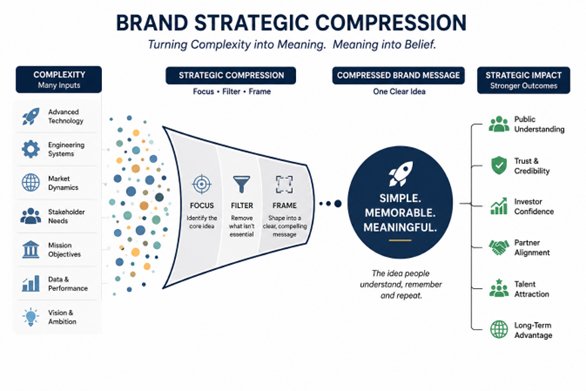
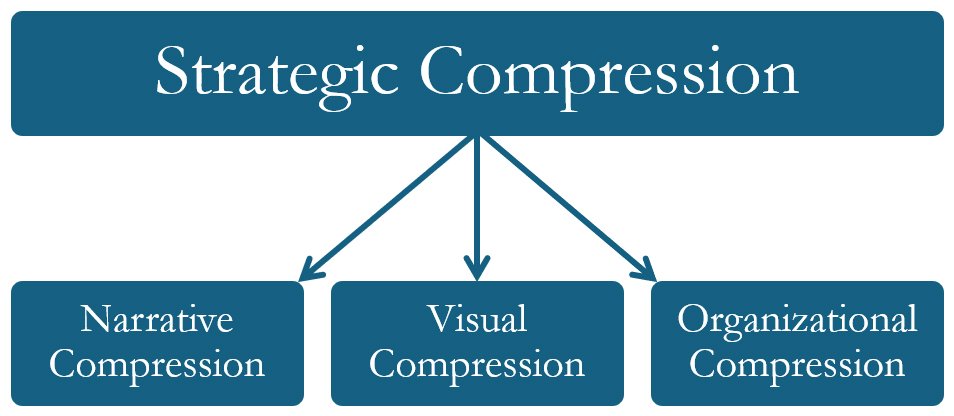
This process operates across several communication layers simultaneously.

First, there is narrative compression.

Narrative compression distills broad institutional missions into memorable conceptual frameworks. NASA historically mastered this approach through language centered around exploration, discovery, and human advancement. Even the phrase “Mission Control” became culturally symbolic because it compressed authority, competence, discipline, and calm operational mastery into a recognizable identity construct.

Another example is the Artemis program. The name itself strategically compresses multiple ideas simultaneously:

  • Return to the Moon
  • Continuity with Apollo mythology
  • Inclusion through the symbolic female counterpart to Apollo
  • Renewal of American lunar leadership
  • Preparation for Mars

The program name performs strategic storytelling before audiences ever study mission architecture.

Second, there is visual compression.

Space organizations communicate powerfully through imagery long before audiences read technical documents or press releases. Rocket landings, astronaut photography, mission patches, launch cinematography, lunar renderings, and even typography all function as compressed symbolic signals.

The image of astronauts standing beside the American flag on the Moon remains globally recognizable because it compressed an entire geopolitical era into a single visual event.

Modern commercial firms increasingly understand this dynamic. Launch livestream aesthetics, factory tour cinematography, animated mission graphics, executive stage presentations, and spacecraft renderings now operate as strategic communication infrastructure rather than simple promotional material.

SpaceX booster landings are a modern example of visual compression. Audiences watching a first-stage booster land vertically instantly understand several messages simultaneously:

  • Technological advancement
  • Reusability
  • Precision
  • Lower-cost future access to space
  • Engineering superiority

The image communicates more efficiently than technical white papers ever could.

Third, there is organizational compression.

Internally, strategic compression aligns teams around coherent priorities. Organizations frequently weaken themselves by attempting to communicate too many strategic identities simultaneously. A company cannot credibly position itself as revolutionary, cautious, scientific, disruptive, institutional, grassroots, premium, and populist all at once without creating narrative fragmentation.

The strongest space brands achieve clarity through disciplined identity concentration.

For example, Planet Labs compressed its identity around daily Earth observation and planetary-scale data accessibility. This focused narrative clarity helped distinguish the company within an increasingly crowded satellite imaging market.

Similarly, Axiom Space consistently compresses its positioning around the idea of building the next era of commercial human presence in low Earth orbit. The company’s communications architecture reinforces themes of transition, commercialization, and orbital permanence.

This does not mean oversimplification.

One of the greatest dangers in modern space communication is confusing strategic compression with hype. Compression is not propaganda. It is not exaggeration. It is not spectacle detached from operational reality.

Effective strategic compression clarifies authentic strategic direction.

Poor strategic compression creates fragile mythologies unsupported by substance.

This distinction matters enormously in the space sector because the industry operates under conditions where operational failure carries unusually high visibility. Overpromising without corresponding capability eventually destroys credibility. Organizations that compress themselves into narratives of inevitability, perfection, or invulnerability often create reputational instability when inevitable setbacks occur.

The collapse of several overhyped space startups demonstrated this clearly. Some firms generated enormous publicity around futuristic renderings and transformational rhetoric while lacking operational maturity, sustainable financing, or realistic execution timelines. Their strategic compression became disconnected from organizational reality.

This is particularly important within founder-centric space brands.

Modern commercial space culture increasingly revolves around entrepreneurial mythology. Executive personalities frequently become compressed symbolic representations of entire organizations. While this can accelerate public attention and investment interest, it can also produce strategic vulnerability if institutional identity becomes overly dependent upon individual reputation.

For communications professionals, the objective is therefore balance.

The goal is to create strategic clarity without sacrificing institutional resilience.

The future leaders of the space economy will not necessarily be the organizations with the most advanced technology alone. They will be the organizations most capable of communicating why their technology matters within humanity’s larger future.

This is especially true as the industry expands toward lunar infrastructure, orbital manufacturing, deep space logistics, commercial stations, resource extraction, and long-duration human presence beyond Earth. Public understanding of these systems will increasingly depend upon communication professionals capable of translating abstract technical frameworks into coherent human narratives.

Strategic compression ultimately functions as a bridge between expertise and belief.

And within the modern space economy, belief is no longer secondary to infrastructure.

It is part of the infrastructure itself.

About the Author

Michael Daily, APR, has been providing strategic communications and branding strategy expertise and support to organizations since 1996. He is the owner of NewSpace Brand Builders, a firm specializing in strategic communications and brand design, strategy, and management within the Space and Defense Industry. You can reach Mike at mike.daily@newspacebb.com

The global space industry is entering an era where communication velocity increasingly determines strategic influence.

Launches occur weekly. New commercial ventures emerge constantly. Nations compete for symbolic leadership. Investors search for clarity within technical complexity. Public audiences consume information through fragmented digital channels measured in seconds rather than sustained attention spans. In this environment, one of the most important yet underexamined disciplines within space communications is the concept of strategic compression.

Strategic compression is the process of reducing a large, multidimensional, technically complex idea into a concentrated narrative or symbolic form that can be rapidly understood, emotionally retained, and consistently repeated by target audiences.

For space communications professionals, this is no longer optional.

Table of Contents

The global space industry is entering an era where communication velocity increasingly determines strategic influence.

Launches occur weekly. New commercial ventures emerge constantly. Nations compete for symbolic leadership. Investors search for clarity within technical complexity. Public audiences consume information through fragmented digital channels measured in seconds rather than sustained attention spans. In this environment, one of the most important yet underexamined disciplines within space communications is the concept of strategic compression.

Strategic compression is the process of reducing a large, multidimensional, technically complex idea into a concentrated narrative or symbolic form that can be rapidly understood, emotionally retained, and consistently repeated by target audiences.

For space communications professionals, this is no longer optional.

It is operationally essential.

The modern space sector is inherently difficult for public audiences to interpret. Most stakeholders outside the industry cannot meaningfully evaluate orbital mechanics, launch architectures, propulsion systems, autonomous rendezvous capability, payload integration procedures, or lunar resource extraction frameworks. The technical sophistication of the industry often exceeds the communication literacy of the audiences organizations must influence.

This creates a dangerous strategic gap.

When organizations fail to compress complexity into understandable meaning, audiences default to confusion, indifference, or narrative substitution generated by competitors, media speculation, or public misconception. The organizations that succeed in the modern space economy are increasingly those capable of translating technical ambition into emotionally accessible strategic identity.

In simple terms, strategic compression converts complexity into belief.

This principle has existed since the beginning of the space age.

The Apollo program was one of the greatest examples of strategic compression in modern history. The United States government condensed immense geopolitical competition, technological advancement, industrial mobilization, and ideological positioning into a singular narrative understood globally: America was going to the Moon.

That phrase compressed an extraordinary amount of meaning:

  • National confidence
  • Scientific superiority
  • Industrial capability
  • Democratic ambition
  • Technological leadership
  • Civilizational optimism

The public did not need to understand rocket staging sequences or navigation algorithms to understand what Apollo represented. The narrative architecture performed the strategic work.

The same principle operates today throughout the commercial space ecosystem.

SpaceX may operate some of the most technically sophisticated launch and spacecraft systems in history, yet its most strategically powerful communication asset may be a single compressed phrase: “Making life multiplanetary.”

That statement transforms highly complex engineering programs into a civilizational narrative ordinary audiences can emotionally process. It compresses:

  • Mars colonization
  • Long-term species survival
  • Reusable launch economics
  • Human expansion
  • Entrepreneurial ambition
  • Future-oriented optimism

into one memorable conceptual framework.

Another example is Blue Origin and its long-running phrase, “Gradatim Ferociter,” or “Step by Step, Ferociously.” The phrase strategically compresses the company’s public identity into disciplined, long-term infrastructure building rather than rapid public spectacle. It communicates patience, methodical advancement, engineering seriousness, and generational ambition.

Likewise, Rocket Lab effectively compresses its positioning around responsiveness and accessibility for small satellite operators. Its branding architecture consistently communicates agility, precision, frequency, and commercial practicality rather than grand civilizational rhetoric. This strategic compression allows Rocket Lab to occupy a distinct psychological position within the broader launch marketplace.

National space programs also employ strategic compression extensively.

China has strategically compressed much of its modern space identity around themes of national rejuvenation, technological self-sufficiency, and disciplined long-term advancement. The country’s space achievements are consistently framed as evidence of national modernization and geopolitical maturity.

India successfully compressed the narrative surrounding the Chandrayaan-3 lunar landing into a story of cost-effective innovation, national pride, and emerging technological leadership. Global audiences repeatedly focused on one central compressed message: India reached the Moon efficiently and affordably.

Even smaller nations leverage strategic compression effectively.

Luxembourg strategically positioned itself as a hub for commercial space finance and space resource policy. Rather than attempting to compete directly with superpowers in launch capability, Luxembourg compressed its national space identity into a focused concept: the business and legal gateway of the future space economy.

This is strategic compression functioning at a national branding level.

For communications professionals working within the space sector, understanding this mechanism is critical because the industry increasingly operates inside an attention economy. Visibility, public trust, investor confidence, talent acquisition, government support, and partnership attraction are all shaped by narrative clarity.

The challenge is that many space organizations communicate as engineers while expecting audiences to respond emotionally.

They overwhelm stakeholders with technical detail while underinvesting in symbolic coherence.

A launch company may describe propulsion specifications without clearly communicating why its existence matters. A satellite startup may explain data architecture while failing to articulate its strategic role within the future global economy. A national space initiative may discuss policy frameworks without constructing a compelling public narrative around national identity, exploration, or long-term societal value.

For example, many early small launch startups focused communications almost entirely on payload mass, engine architecture, and orbital insertion capability. Meanwhile, companies with stronger strategic compression framed themselves around larger emotionally resonant concepts such as accessibility, democratization of space, national resilience, or orbital infrastructure development. The latter group often generated greater investor and media attention even when technical differences between competitors were relatively narrow.

Strategic compression solves this problem by identifying the core idea an organization wants permanently associated with its identity.

This process operates across several communication layers simultaneously.

First, there is narrative compression.

Narrative compression distills broad institutional missions into memorable conceptual frameworks. NASA historically mastered this approach through language centered around exploration, discovery, and human advancement. Even the phrase “Mission Control” became culturally symbolic because it compressed authority, competence, discipline, and calm operational mastery into a recognizable identity construct.

Another example is the Artemis program. The name itself strategically compresses multiple ideas simultaneously:

  • Return to the Moon
  • Continuity with Apollo mythology
  • Inclusion through the symbolic female counterpart to Apollo
  • Renewal of American lunar leadership
  • Preparation for Mars

The program name performs strategic storytelling before audiences ever study mission architecture.

Second, there is visual compression.

Space organizations communicate powerfully through imagery long before audiences read technical documents or press releases. Rocket landings, astronaut photography, mission patches, launch cinematography, lunar renderings, and even typography all function as compressed symbolic signals.

The image of astronauts standing beside the American flag on the Moon remains globally recognizable because it compressed an entire geopolitical era into a single visual event.

Modern commercial firms increasingly understand this dynamic. Launch livestream aesthetics, factory tour cinematography, animated mission graphics, executive stage presentations, and spacecraft renderings now operate as strategic communication infrastructure rather than simple promotional material.

SpaceX booster landings are a modern example of visual compression. Audiences watching a first-stage booster land vertically instantly understand several messages simultaneously:

  • Technological advancement
  • Reusability
  • Precision
  • Lower-cost future access to space
  • Engineering superiority

The image communicates more efficiently than technical white papers ever could.

Third, there is organizational compression.

Internally, strategic compression aligns teams around coherent priorities. Organizations frequently weaken themselves by attempting to communicate too many strategic identities simultaneously. A company cannot credibly position itself as revolutionary, cautious, scientific, disruptive, institutional, grassroots, premium, and populist all at once without creating narrative fragmentation.

The strongest space brands achieve clarity through disciplined identity concentration.

For example, Planet Labs compressed its identity around daily Earth observation and planetary-scale data accessibility. This focused narrative clarity helped distinguish the company within an increasingly crowded satellite imaging market.

Similarly, Axiom Space consistently compresses its positioning around the idea of building the next era of commercial human presence in low Earth orbit. The company’s communications architecture reinforces themes of transition, commercialization, and orbital permanence.

This does not mean oversimplification.

One of the greatest dangers in modern space communication is confusing strategic compression with hype. Compression is not propaganda. It is not exaggeration. It is not spectacle detached from operational reality.

Effective strategic compression clarifies authentic strategic direction.

Poor strategic compression creates fragile mythologies unsupported by substance.

This distinction matters enormously in the space sector because the industry operates under conditions where operational failure carries unusually high visibility. Overpromising without corresponding capability eventually destroys credibility. Organizations that compress themselves into narratives of inevitability, perfection, or invulnerability often create reputational instability when inevitable setbacks occur.

The collapse of several overhyped space startups demonstrated this clearly. Some firms generated enormous publicity around futuristic renderings and transformational rhetoric while lacking operational maturity, sustainable financing, or realistic execution timelines. Their strategic compression became disconnected from organizational reality.

This is particularly important within founder-centric space brands.

Modern commercial space culture increasingly revolves around entrepreneurial mythology. Executive personalities frequently become compressed symbolic representations of entire organizations. While this can accelerate public attention and investment interest, it can also produce strategic vulnerability if institutional identity becomes overly dependent upon individual reputation.

For communications professionals, the objective is therefore balance.

The goal is to create strategic clarity without sacrificing institutional resilience.

The future leaders of the space economy will not necessarily be the organizations with the most advanced technology alone. They will be the organizations most capable of communicating why their technology matters within humanity’s larger future.

This is especially true as the industry expands toward lunar infrastructure, orbital manufacturing, deep space logistics, commercial stations, resource extraction, and long-duration human presence beyond Earth. Public understanding of these systems will increasingly depend upon communication professionals capable of translating abstract technical frameworks into coherent human narratives.

Strategic compression ultimately functions as a bridge between expertise and belief.

And within the modern space economy, belief is no longer secondary to infrastructure.

It is part of the infrastructure itself.

About the Author

Michael Daily, APR, has been providing strategic communications and branding strategy expertise and support to organizations since 1996. He is the owner of NewSpace Brand Builders, a firm specializing in strategic communications and brand design, strategy, and management within the Space and Defense Industry. You can reach Mike at mike.daily@newspacebb.com