


Brand as Risk Management in the Space Industry Supply Chain
In the space industry, technical innovation has never been the full story. Engineering excellence, scientific ambition, and capital investment are necessary, but they are not sufficient. Space organizations operate in an environment defined by extraordinary stakes, layered complexity, and constant change. In this environment, perception matters. Trust matters. Alignment matters. Often, they matter as much as propulsion systems, payload mass, or orbital mechanics.
This is where brand strategy enters the picture, not as promotion, but as risk management.
At its core, a branding and marketing strategy company exists to solve a fundamental problem for space industry organizations: how to clearly define, communicate, and position value in a complex, competitive, and rapidly evolving ecosystem. The purpose is not visibility for its own sake. The purpose is to attract funding, secure partnerships, win customers, satisfy regulators, and maintain public trust in an industry where confidence is fragile and consequences are real.
When branding is done correctly, it creates clarity where complexity dominates, trust where uncertainty persists, and resilience where volatility is the norm. In the space industry supply chain, that function is not optional. It is mission-critical.
Table of Contents
The Brand Challenge Inside the Space Industry
Every space organization, whether a prime contractor, integrator, Tier supplier, startup, or sovereign entity, faces the same underlying challenge: translating deeply complex technical missions into something that diverse stakeholders can understand, evaluate, and believe in.
A strategic branding and marketing firm helps organizations navigate this challenge by bringing structure and coherence to how they present themselves to the world. This begins with identity. Space missions are intricate by nature, but stakeholders do not fund complexity, regulate complexity, or partner with complexity. They fund, regulate, and partner with clarity. Brand strategy turns technical vision into a narrative that stakeholders can understand, trust, and champion.
Differentiation is the next hurdle. The NewSpace economy has introduced an expanding field of organizations with overlapping technologies, services, and aspirations. Without a clear brand position, even technically superior organizations risk blending into the background. Branding defines why an organization matters, how it is distinct, and where it fits in the broader ecosystem.
Credibility follows closely behind. Investors, regulators, customers, and partners all ask the same question, sometimes silently and sometimes directly: Can this organization be trusted to deliver? A strong brand signals competence, reliability, and mission alignment long before a contract is signed or a payload is launched.
The challenge is compounded by the need to speak to multiple audiences at once. Government agencies, defense stakeholders, commercial partners, investors, and the public each listen through a different lens. Brand strategy aligns these narratives so that the message remains consistent, even as it is adapted to each audience.
Finally, there is the challenge of sustained visibility. The space ecosystem does not stand still. New competitors emerge, technologies evolve, and priorities shift. Branding ensures that an organization remains relevant, recognized, and trusted as the landscape changes.
In an industry where partnerships and perception can determine mission success, branding translates technical ambition into strategic presence. It is the bridge between what an organization builds and whether the world believes in it.
Stress as a Structural Feature of the Space Ecosystem
Stress in the space industry is not incidental. It is structural.
Professionals operate at the intersection of high stakes, high complexity, and accelerating timelines. Technical, financial, political, and public pressures collide with little margin for error. Projects routinely involve billions of dollars, years or decades of preparation, and consequences that extend far beyond balance sheets.
Timelines are compressed by competitive launches, procurement cycles, and investor expectations. Technological uncertainty is inherent, because space work often pushes beyond established precedent. Funding pressure is constant, with capital tied to milestones, confidence, and momentum. Regulatory and political environments shift rapidly, influenced by policy changes, export controls, and geopolitical dynamics. Meanwhile, market volatility defines the NewSpace era, where new entrants appear quickly and disappear just as fast.
Layered onto these pressures are familiar risk factors. Reputation risk is magnified by global media scrutiny, where failures and delays are highly visible. Stakeholder complexity demands careful balance among governments, investors, partners, customers, and the public. Global collaboration introduces cultural, geographic, and coordination challenges. Increasingly, organizations must also demonstrate how space activity benefits Earth, aligning with sustainability and ESG expectations.
The reality is simple: stress in the space industry comes from operating at the edge of possibility while carrying political, financial, and reputational consequences that demand precision, credibility, and speed.
How Branding Reduces Uncertainty and Pressure
Branding and marketing do not eliminate risk. Space will always be unforgiving. What they do is reduce uncertainty, confusion, and stakeholder anxiety. They replace ambiguity with clarity and fragmentation with alignment.
A strong reputation increases tolerance for setbacks in high-risk, high-cost programs. Stakeholders are more patient when they trust the organization behind the mission. Clear mission narratives align internal teams and external partners, reducing miscommunication and friction under compressed timelines. Thoughtful brand positioning translates evolving technical capabilities into understandable value, maintaining support through inevitable pivots and challenges.
In funding environments, a credible and differentiated brand instills confidence, helping organizations stand out when capital is scarce. In regulatory and political contexts, brand positioning that emphasizes responsibility, compliance, and alignment with global priorities builds resilience against policy shifts. During periods of market volatility, consistent visibility and thought leadership maintain relevance and signal stability.
Branding also plays a critical role in reputation management. Transparent communication, established in advance, mitigates damage when incidents occur. Stakeholder-specific messaging maintains relationships across complex audiences without diluting core identity. Unified brand standards support coordination across cultures and geographies. Sustainability messaging connects space activity to Earth benefit, addressing public and institutional expectations.
The result is a cushion of trust. That trust creates room to maneuver, resilience during setbacks, and leverage when negotiating partnerships, funding, and contracts.
Brand as Risk Management
The central premise is straightforward: a strong, consistent, and trusted brand acts as a buffer against volatility, setbacks, and competitive pressure in the space industry supply chain. It enables organizations to sustain momentum under conditions that would otherwise stall or derail progress.
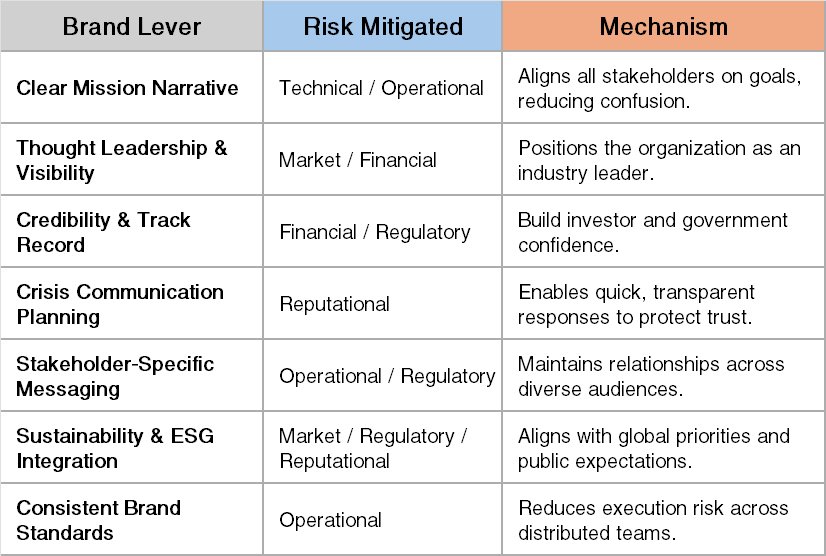
Space organizations face technical risk, financial risk, market risk, regulatory risk, reputational risk, and operational risk. Brand strategy addresses each through specific levers. A clear mission narrative aligns stakeholders and reduces confusion. Thought leadership and visibility position the organization as an industry leader, supporting market and financial confidence. Credibility built through track record reassures investors and regulators. Crisis communication planning protects trust when things go wrong. Stakeholder-specific messaging maintains operational and regulatory relationships. Sustainability and ESG integration align the brand with global priorities. Consistent brand standards reduce execution risk across distributed teams.
The cause-and-effect relationship is predictable. A strong brand presence builds stakeholder trust. Trust increases risk tolerance. Higher tolerance enables faster recovery from setbacks. Faster recovery sustains access to markets, capital, and partnerships.
The strategic payoff is measurable. Trust capital softens the impact of failure. Brand equity improves negotiation leverage. Market relevance is preserved through turbulence. Over time, strong brands create barriers that competitors struggle to overcome.
Conclusion
In the NewSpace era, branding is no longer a secondary function. It is a strategic asset and a form of risk management. For organizations operating in a high-risk, high-reward environment, brand strategy is the connective tissue that holds stakeholder trust, competitive positioning, and long-term sustainability together.
A strong brand does more than tell a story. It protects the mission.
About the Author
Michael Daily, APR, has been providing strategic communications and branding strategy expertise and support to organizations since 1996. He is the owner of NewSpace Brand Builders, a firm specializing in strategic communications and brand design, strategy, and management within the Space and Defense Industry. You can reach Mike at mike.daily@newspacebb.com
Article photo provided by isdc.nss.org