


Key Considerations
When most people think of the space industry, they imagine rockets launching into orbit, satellites orbiting Earth, or ambitious plans to colonize Mars. But for those of us working in strategic communications and brand strategy, the real launchpad is not in the sky – it is in perception. How a space company is positioned in the minds of investors, partners, regulators, and the public can be just as critical as the engineering feats it achieves.
Brand positioning in the Starconomy comes with unique challenges. Unlike consumer brands, where messaging focuses primarily on lifestyle, aspiration, or price, space brands operate in a highly technical, heavily regulated, and deeply networked environment. Positioning requires a dual lens: credibility grounded in technical expertise and clarity in a complex ecosystem crowded with competitors.
Table of Contents
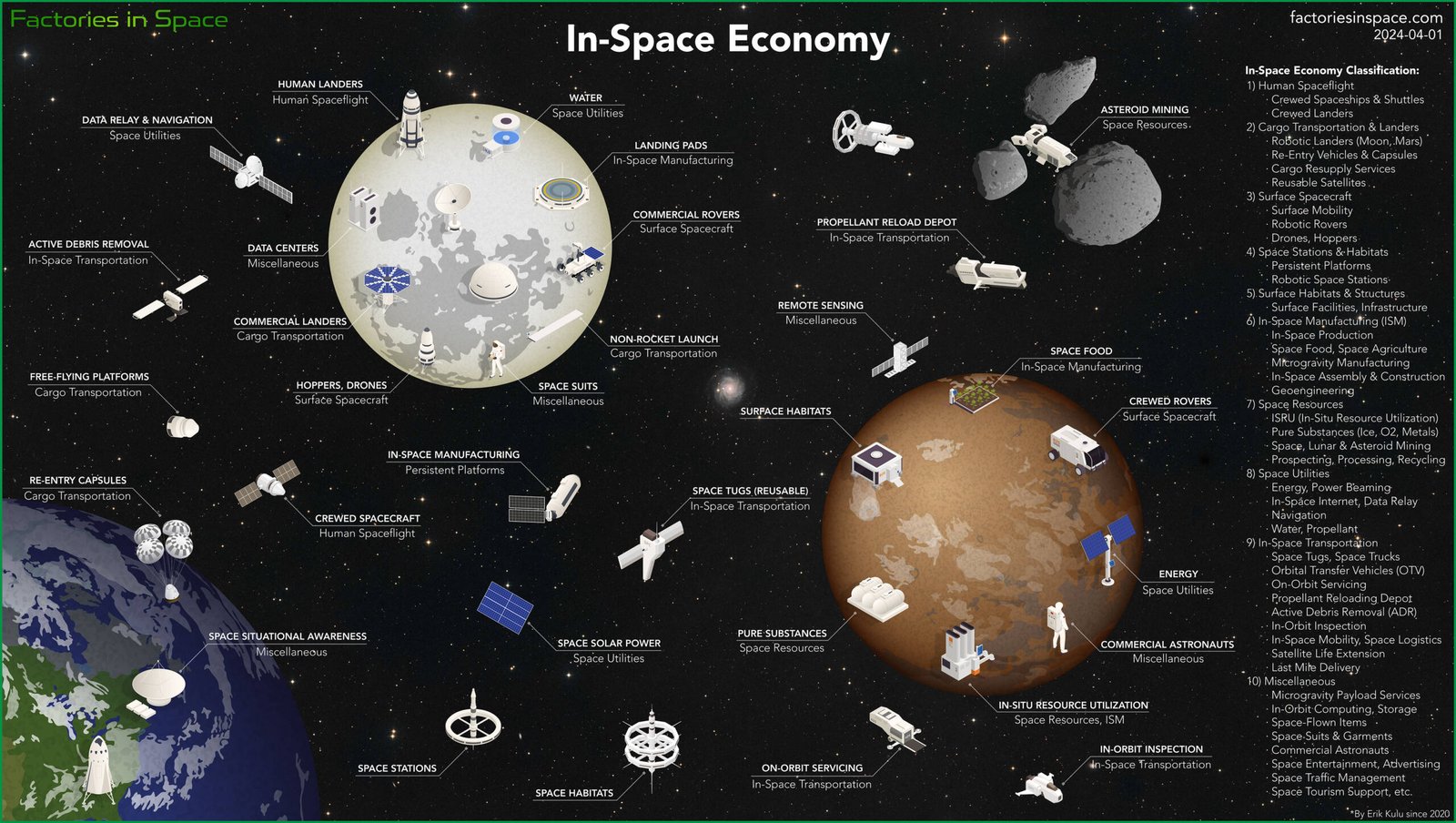
Image Source: Erik Kulu – Factories in Space
Understand the Starconomy
The first rule is simple: know the terrain. The Starconomy, as defined by industry analysts and researchers, spans government contractors, commercial launch providers, satellite operators, space infrastructure firms, and even supporting industries like insurance, law, and finance. Each sector has its own language, expectations, and metrics for success. A satellite manufacturer, for example, must position itself differently to a venture capital firm than to a defense customer. In both cases, trust, reliability, and proven expertise are key differentiators.
Take Rocket Lab, a small satellite launch provider. Early in its development, Rocket Lab positioned itself as “frequent, affordable, and reliable” for small satellite operators—a clear, focused promise that set it apart from heavy-lift competitors like SpaceX and Blue Origin. This positioning helped the company build credibility with a very specific segment of the market while signaling its value proposition to investors and partners.
Clarity Over Complexity
Space brands often face a paradox: the technology is inherently complex, yet the positioning must be simple and digestible. Overloading stakeholders with technical jargon can dilute a brand’s promise. Instead, the goal is to translate capability into benefit. For example, Maxar Technologies does not just sell satellite imagery; it communicates “actionable intelligence from space” – a concise statement that aligns its technical expertise with tangible business outcomes. Clear positioning like this is what builds differentiation in a crowded Starconomy.
Position for Credibility and Trust
In space, reputation is everything. Launch failures, delays, or miscommunications can ripple across the entire ecosystem. Brands must build credibility through transparency, consistent messaging, and validation from third-party certifications or partnerships. For instance, Blue Origin emphasizes its engineering pedigree and the experience of founder Jeff Bezos, while simultaneously showcasing partnerships with NASA—positioning the company as both innovative and reliable.
Know Your Stakeholders
Unlike traditional industries, the Starconomy has multiple, often overlapping audiences: investors, regulatory agencies, partners, suppliers, media, and end-users. Each has different expectations and influences brand perception. SpaceX, for instance, has cultivated a distinct brand for each audience: cutting-edge innovation and aspirational vision for the public, operational reliability and cost efficiency for commercial customers, and strategic alignment with national priorities for government agencies. This multi-dimensional positioning is intentional and requires deep audience insights.
Embrace Storytelling
Finally, positioning in the Starconomy thrives on narrative. Humans connect with stories, even in highly technical fields. Framing your brand through mission-driven storytelling – whether it is advancing human spaceflight, democratizing access to space, or enabling Earth observation for sustainability – creates emotional resonance that complements technical credibility. NASA’s Artemis program, for example, positions itself not just as a mission to the Moon, but as a global partnership advancing science, innovation, and human exploration.
Conclusion
Space may be the final frontier, but brand positioning in the Starconomy begins firmly on the ground. Successful brands are those that understand their ecosystem, clarify their value, establish credibility, engage stakeholders thoughtfully, and tell compelling stories. For space companies, positioning is not an optional marketing exercise – it is a strategic necessity that can define success in a highly competitive, high-stakes environment.
For those navigating this unique landscape, my advice is simple: think like an engineer, speak like a storyteller, and position your brand with both rigor and imagination. After all, in space, perception is as powerful as propulsion.
About the Author
Michael Daily, APR, has been providing strategic communications and branding strategy expertise and support to organizations since 1996. He is the owner of NewSpace Brand Builders, a firm specializing in strategic communications and brand design, strategy, and management within the Space and Defense Industry. You can reach Mike at mike.daily@newspacebb.com