After the Failure: How a Space Component Manufacturer Reclaims Credibility within 72 Hours of a Mission Loss
This article explores a high-stakes reality of the space industry: what happens in the critical first 72 hours after a mission failure. Through a compelling scenario and real-world parallel, it reveals how a space component manufacturer must balance…
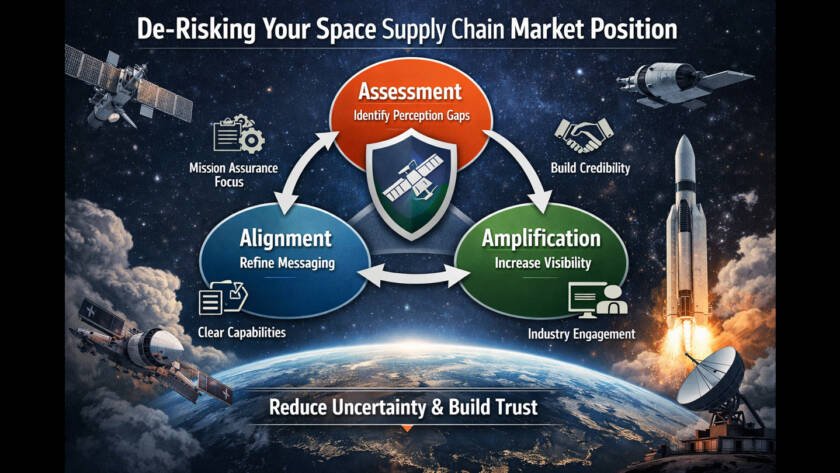
A Practical Way to De-Risk Your Space Supply Chain Market Position
The modern space industry runs on ambition, engineering excellence, and an increasingly complex web of suppliers. Launch providers, satellite manufacturers, propulsion developers, ground systems companies, software firms, materials specialists, and logistics providers all contribute to the ecosystem. Yet within this network lies a quiet…
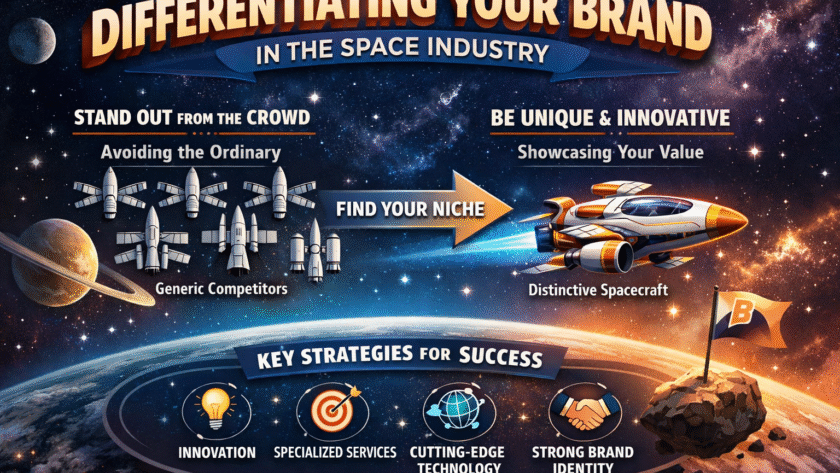
Differentiating Your Space Brand from the Competition
During brand strategy audits the very first question I ask a perspective client is: “what makes you different from your competition?” It’s a simple straight forward question, but it is surprising how difficult it is for many businesses to answer.
Brand differentiation is the act of making…
What Successful Space Suppliers Do Differently
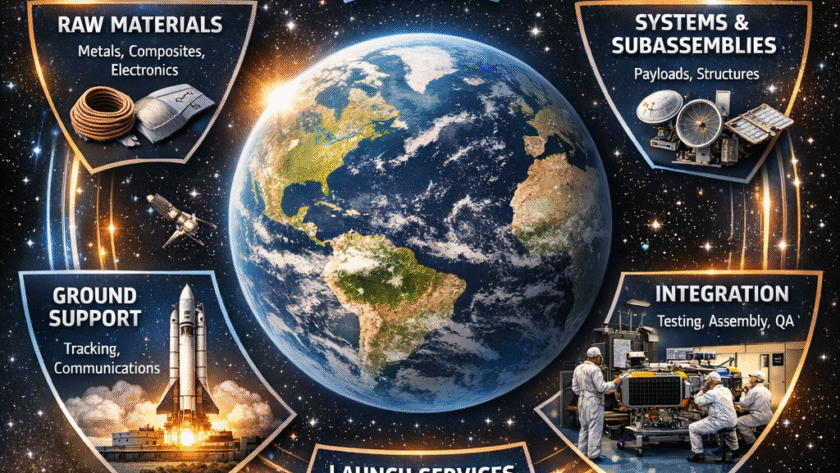
The space supply chain is not a chain. It is a constellation. And in that constellation, some suppliers burn steadily like Polaris while others flicker briefly and disappear into the cold vacuum of irrelevance. The difference is rarely technical capability alone. In space, everyone is technically competent. The difference…
The Space Future is a Communications Problem
The space future will not be adopted by technology alone. It will be accepted, trusted, and sustained through meaning. That responsibility belongs, in large part, to space communications professionals- an integrated team of corporate communicators, business developers, marketers, public relations specialists and sales professionals.
Every era that successfully…
Trust Before Transaction: How Strategic Branding Accelerates Sales in the Space Supply Chain
In the space supply chain, sales do not unfold like traditional commercial transactions. They are long, layered, and governed as much by perception as by performance. Decisions move through engineers, procurement officers, program managers, risk committees, and executive leadership, each…
Why Supply Chain Branding Matters in Space
Space technology innovation does not occur in isolation. It is the cumulative outcome of coordinated risk across design, manufacturing, integration, launch, and operations. Within that system, supply chain branding strategy plays a quiet but decisive role. It does not make innovation louder. It makes innovation survivable.
In space,…
Three Brand Signals Space Industry Prime Contractors Notice Immediately
In today’s space economy (the “Starconomy”), prime contractors begin evaluating potential partners long before a request for proposal ever appears. By the time procurement becomes formal, opinions are often already formed. Technical capability still matters, but it is no longer the first filter. What primes notice…
Why Space Supply Chain Companies Lose Credibility Before the Technical Review In the space supply chain, technical capability often dominates the conversation. Engineers, program managers, and business development teams focus on performance metrics, schedules, and cost. Yet, the companies that consistently earn prime contractor attention and long-term partnership opportunities understand that technical excellence alone does…
Before the Technical Review: How Brand Ambiguity Causes Space Suppliers to Stall In the space industry, hesitation often sets in long before a technical review ever takes place. It appears quietly, during early conversations, informal briefings, and first impressions that never quite cohere. For many space suppliers, the challenge is not engineering capability or program…
How Trust, Signal Strength, and Operational Alignment Build Enduring Advantage in a High-Stakes Industry
In the space ecosystem, credibility is not a marketing outcome. It is a survival requirement.
Organizations operating across launch, satellite, ground systems, data services, manufacturing, and enabling technologies exist in an environment defined by irreversible decisions, long development cycles, public accountability,…
Brand as Risk Management in the Space Industry Supply Chain
In the space industry, technical innovation has never been the full story. Engineering excellence, scientific ambition, and capital investment are necessary, but they are not sufficient. Space organizations operate in an environment defined by extraordinary stakes, layered complexity, and constant change. In this environment, perception…